Category Guides
Animals: A Category Guide
What separates an animal photograph that places in IPPAWARDS: proximity over reach, a moment of behaviour, and a background that isolates the subject. Wildlife is only half the category.

Animals is the category most entrants assume needs reach: a long lens, a hide, and patience measured in mornings. The archive says otherwise. What places in IPPAWARDS is rarely magnification. It is adjacency, the frame made close enough that the animal's own behaviour becomes the subject instead of a detail inside a landscape.
The winning entries are also rarely the most exotic. In 2026 first place went to two Labradors looking out through a window, and second to a shaggy Icelandic horse standing in a white field. Both were made on phones that fit in a pocket, and both work because of decisions taken in the two seconds before the shutter.
What the category rewards
Three things recur in the Animal winners. Proximity: the animal holds a real portion of the frame, so the eye can read fur, feather, skin, eye. A moment of behaviour: an interaction, a look, a movement that will not exist five seconds later. And a clean stage: a background that isolates, whether it is blown to white or dropped into shadow. Miss any of the three and the picture reads as a snapshot of an animal rather than a photograph of one.

Peter Crome's first place in 2026 is a good demonstration of the third. Two dogs appear in the gap between drawn roman shades in a chipped white window, held between brickwork and a dark hedge. The animals are barely doing anything. The architecture is doing the composing, and the pale eyes against the pale shades are what the frame is really about.
Get close enough to stop zooming
The reflex is to zoom. Zoom is useful, but it flattens: the 3x and 5x cameras buy compression and give up the relationship between the animal and the place it is standing in. The alternative is patience with the main camera or the 2x crop, walking nearer than feels comfortable, and letting the animal decide how close you are allowed to be. If it moves away, you were too close; if it stays, keep going.
Barry Mayes's second place in 2026 was made at 77mm on an iPhone 13 Plus, close enough that the horse's coat fills the frame twice over and the winter sky behind it goes to white. A shorter lens at that distance does more than a longer lens from the gate.

Shot details
- iPhone
- iPhone 13 Plus
- Lens
- 9mm (77mm equiv), f/2.8
- Mode
- Photo, 1/960s, ISO 32
Wait for the behaviour
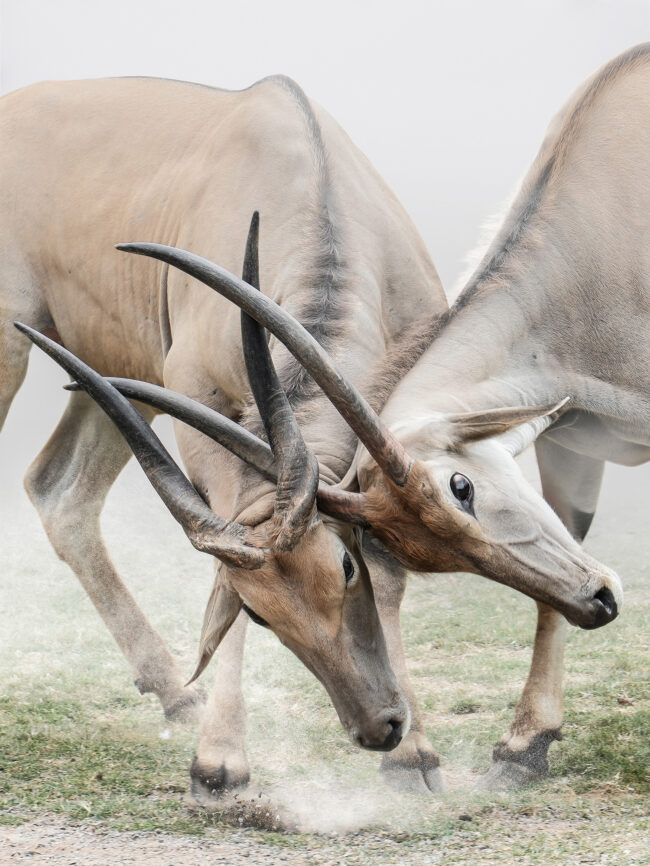
An animal standing still is a subject; an animal doing something is a photograph. Kunhua Chen's Gladiator, third place in 2025 and made on an iPhone 11 at Chimelong, is two antelope with their horns locked and dust coming off the ground between them. Nothing about that frame was arranged. It was repetition and waiting for the second when both heads meet.
The practical version is unglamorous. Pick one animal, lower the phone, and watch for five minutes before you make anything. Then shoot in bursts through the moment rather than single frames around it, and expect the sharp one to be the third or fourth of the sequence. Keep a second finger free to lock focus on the eye, and tap once when the animal turns so exposure does not chase the background.
Colour, reflection, repetition
Not every animal frame needs one hero subject. Boyu Wen's third place in 2026, made at 200mm in Yangpu, Shanghai, is a flock of flamingos standing in dark water with dense bamboo behind them. What carries it is repetition and colour: the warm pink against near-black green, and the birds answering their own reflections in the water. A group read as pattern is a different pleasure from a single gaze, and the category rewards both.


The animal next door
A large share of the shortlist is not wildlife. Pets, farm animals, zoo animals and street animals all belong here, because the category is Animals rather than Nature. Domestic subjects come with an advantage no safari can match: the same animal, the same light, a hundred attempts. Most entrants who move up a category do it on a subject they can photograph every day.
Before you press the shutter
- Is the eye in focus and near enough to the frame to matter?
- Can you name the behaviour, or is the animal just present?
- Does the background isolate the subject, or divide attention?
- Is the animal's outline clear against what is behind it?
- Have you shot through the moment rather than around it?
- At full size, does the fur or feather detail survive?
Editing, and honesty
Sharpening and denoising are the usual tells in this category. Over-sharpened fur turns wiry, heavy noise reduction turns feather detail into watercolour, and a sky that has been replaced or a bird that has been added ends an entry in review. Crop to improve the composition, not to invent reach: an animal enlarged from a fraction of the frame will not hold up at judging size. Black and white is welcome as long as the conversion is a decision about the subject rather than a way of hiding colour noise.
How to enter an animal photograph
Animals entries go through the normal submission process, one photograph per entry slot, filed in the Animals category. Read the current requirements before you buy a bundle, since file type, resolution and series rules change between cycles, then upload at full resolution rather than the downsized version from your camera roll.
Enter your animal photograph
The strongest animal frames are usually made close to home. Read the guidelines, then choose the one photograph where the animal was doing something.
Entry guidelines